Emirates Living vs Dubai Hills Estate: Two Established Choices for Dubai Family Living
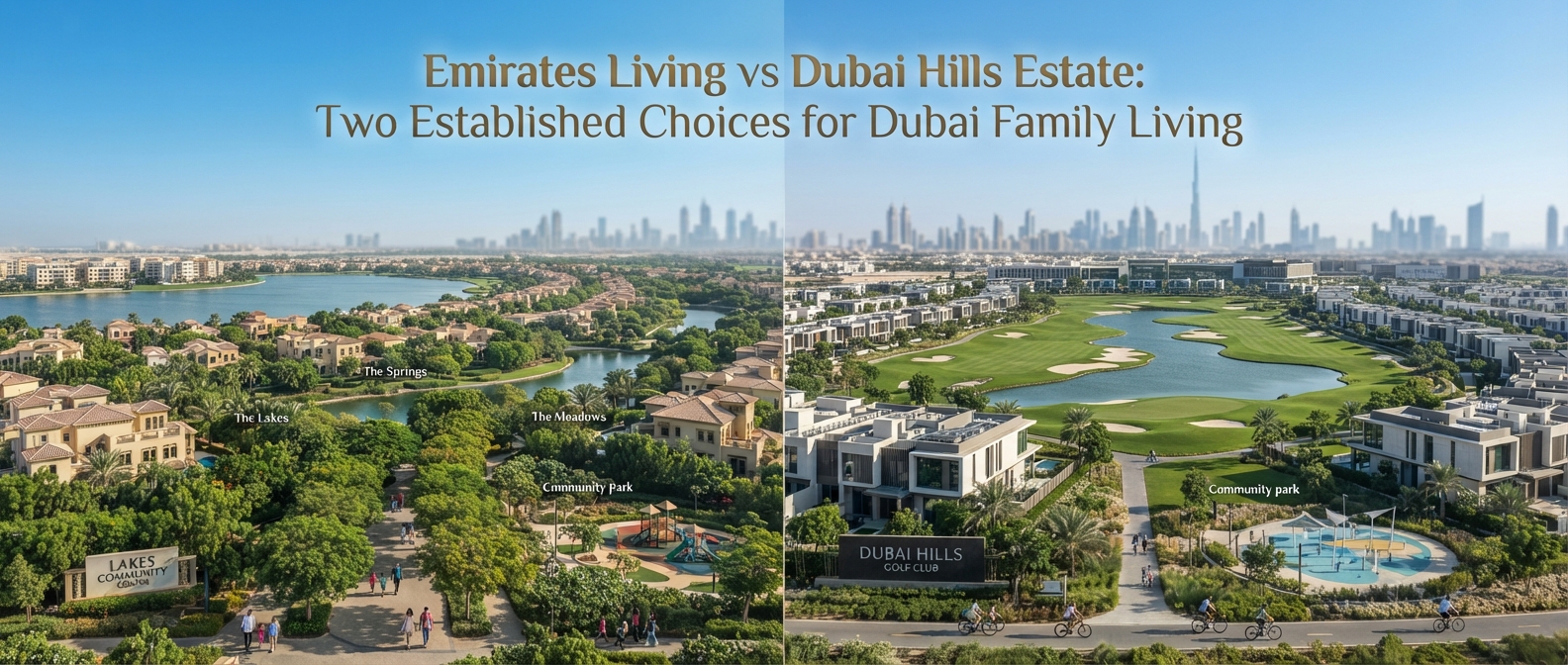
Dubai’s residential market offers very different community experiences, from high-rise urban districts to established villa neighbourhoods and newer master-planned destinations. For buyers researching Property Zone real estate, the choice often comes down to more than price. Lifestyle, connectivity, property type, greenery, amenities, schools and future supply can all influence whether a community fits a particular household or investment strategy.

Two areas that illustrate this contrast are Emirates Living and Dubai Hills Estate. Both are associated with Emaar and offer green, family-oriented environments, but their layouts, property profiles and stages of development create different propositions for Dubai residents and investors.
Emirates Living: Established Green Community Living
Emirates Living was established in 2003 and covers a large residential area built around greenery, landscaped streets, lakes and established neighbourhoods. The wider community includes Emirates Hills, The Lakes, The Meadows, The Springs and Hattan.
For buyers looking for Emirates Living villas, the area’s established character is one of its defining features. Unlike Dubai’s high-rise districts, much of Emirates Living is centred around villas and townhouses, giving residents a lower-density residential environment.
The community includes extensive walking trails, lakes, parks, schools, nurseries, retail facilities and recreational amenities. Emaar currently highlights 70 lakes, 14.2 million square feet of walking trails, three dog parks, three schools, six nurseries and four retail centres across the wider community.
Dubai Hills Estate: A Newer Urban Community
Dubai Hills Estate represents a different stage of Dubai’s residential development.
The master-planned community covers approximately 2,700 acres and forms part of Mohammed Bin Rashid City. It is positioned between Downtown Dubai and Dubai Marina and is connected to Al Khail Road.
The area combines apartments, villas and townhouses with major lifestyle destinations including Dubai Hills Mall, Dubai Hills Golf Club and a large central park.
For buyers researching Dubai Hills Estate properties, this combination of residential neighbourhoods, retail, recreation and accessibility makes the community particularly relevant to households that want a modern master-planned environment.
The Biggest Difference: Established vs Evolving
The most noticeable distinction between Emirates Living and Dubai Hills Estate is the stage of development.
Emirates Living has had decades to establish its neighbourhood identity. Mature landscaping, existing homes, community facilities and established streets give it a settled residential character.
Dubai Hills Estate is newer and continues to evolve as additional residential and commercial components are delivered.
This difference can influence the buying decision.
A buyer who prefers established surroundings may focus on Emirates Living, while someone who wants newer buildings and an evolving community environment may investigate Dubai Hills Estate.
Property Types in Emirates Living
Emirates Living is particularly associated with larger residential homes.
The individual communities within the master development have their own characteristics.
The Springs includes townhouses and detached villas, while The Meadows contains detached villas with larger gardens and outdoor areas. The Lakes is centred around family homes positioned around landscaped lakes, while Hattan features larger luxury villas overlooking the golf course.
Emirates Hills occupies the ultra-premium end of the wider community, with custom-built homes on substantial plots and golf-course and lake surroundings.
This variety means the Emirates Living label alone does not tell the full story of a property’s characteristics.
Property Choices in Dubai Hills Estate
Dubai Hills Estate offers a broader mix of contemporary residential formats.
Across the community, buyers can find apartments, villas and townhouses, with multiple residential projects developed around parks, golf-course areas and community facilities.
The official community portfolio includes developments such as Maple, Sidra, Fairways, Golf Grove, Park Heights, Park Ridge, Elvira, Golf Suites and other residential projects.
This creates more variety for buyers who want a modern apartment as well as those looking for a larger family home.
Lifestyle and Green Spaces
Green space is an important feature of both locations, but it appears in different forms.
Emirates Living is characterised by established lakes, tree-lined streets, landscaped parks and walking trails. Emaar describes the community as a nature-focused residential environment with extensive greenery and recreational facilities.
Dubai Hills Estate is centred around a large central park, with walking and cycling trails, children’s play areas, sports facilities and access to Dubai Hills Golf Club.
For families, these outdoor environments can be an important part of the daily living experience.
Connectivity Across Dubai
Location remains an important part of the property decision.
Emirates Living benefits from its position near major Dubai roads and established employment and residential districts. Emaar describes the community as being approximately five minutes from Dubai Marina and 15 minutes from Downtown Dubai under typical stated travel estimates.
Dubai Hills Estate is positioned between Downtown Dubai and Dubai Marina and is directly associated with Al Khail Road, giving residents access to several major parts of the emirate.
Actual travel times naturally depend on traffic, route and time of day, so buyers should test the commute from the specific property rather than relying solely on area-level estimates.
Amenities and Everyday Convenience
One of the advantages of established master communities is the availability of everyday amenities.
Emirates Living has schools, nurseries, retail centres, restaurants, sports facilities, golf and community clubs. The Lakes Club, for example, includes fitness, swimming and sports facilities, while neighbourhood retail destinations serve residents across the community.
Dubai Hills Estate has developed a similarly broad lifestyle offering, with Dubai Hills Mall, golf, parks, sports facilities, cycling routes and community spaces.
For end users, these facilities can reduce the need to travel outside the community for everyday activities.
Family Considerations
Families often evaluate property differently from investors.
A family may be more interested in:
- Bedroom configuration
- Garden or outdoor space
- School access
- Community security
- Parks
- Retail convenience
- Traffic and commute
- Children’s activities
- Privacy
- Property condition
Emirates Living’s established villa neighbourhoods can appeal to buyers prioritising mature community surroundings.
Dubai Hills Estate provides a more contemporary master-planned environment where apartments, townhouses and villas are integrated with newer retail and recreational facilities.
Emirates Living for Ready-Property Buyers
A significant characteristic of Emirates Living is its established ready-property market.
When purchasing a villa or townhouse in an older community, the physical condition of the individual home becomes particularly important.
Buyers should inspect:
- Structural condition
- Renovation quality
- Plot size
- Built-up area
- Garden
- Parking
- Layout
- Privacy
- Views
- Maintenance history
Two properties within the same community can have substantially different values because of these factors.
This makes property-level due diligence particularly important when considering Emirates Living real estate.
Dubai Hills Estate and Newer Properties
Dubai Hills Estate provides access to many newer residential developments.
For buyers, newer construction can mean contemporary layouts, modern facilities and current building standards.
However, newness should not be considered the only measure of value.
The buyer should still assess service charges, actual usable space, location within the community, views, developer specifications, surrounding construction and competing supply.
A new apartment can have different investment characteristics from an established villa, even if both are located within highly regarded communities.
Rental Market Considerations
Investors comparing the two areas should examine actual rental evidence.
The tenant profile can vary depending on the property type.
A villa in Emirates Living may appeal to families looking for long-term accommodation and larger living spaces.
An apartment in Dubai Hills Estate could attract professionals, couples or families depending on the unit configuration and building.
Rather than assuming one community has stronger rental demand, investors should compare the specific property against comparable homes in the same segment.
Supply and Competition
Future supply is particularly important when evaluating newer communities.
Dubai Hills Estate continues to contain multiple residential developments, meaning investors should understand how many comparable units could compete for tenants or future buyers.
Emirates Living has a more mature built environment, but individual properties still compete based on condition, price, plot size, renovation and location within the community.
The right analysis is therefore not simply:
Emirates Living vs Dubai Hills Estate
It is:
Specific property vs comparable properties within the same target market.
Investment Analysis Should Start With the Property
A community name can create a useful starting point, but it should not replace property-level analysis.
An investor should examine:
Purchase price → Rental income → Service charges → Maintenance → Financing → Future supply → Resale liquidity
This framework can be applied to both Emirates Living and Dubai Hills Estate.
For example, a higher-priced villa may offer more space but also require higher maintenance costs. An apartment may have a lower entry price but could have recurring service charges that materially affect net returns.
Location Within the Community Matters
Large master developments can contain very different micro-locations.
A property closer to retail, schools, parks or major roads can have different characteristics from another property within the same master development.
In Emirates Living, the distinction between The Springs, The Meadows, The Lakes, Hattan and Emirates Hills is significant.
In Dubai Hills Estate, different residential projects can also provide different access to parks, malls, golf facilities and roads.
Therefore, buyers should investigate the exact building or neighbourhood rather than stopping at the master-community level.
Lifestyle vs Investment Objectives
The right property also depends on why someone is buying.
An end user may place greater value on space, privacy and community atmosphere.
An investor may prioritise entry price, rental income and liquidity.
An international buyer may focus heavily on location and ease of property management.
A UAE-based family may care more about schools, commuting and daily convenience.
These different objectives can lead to different conclusions even when buyers are comparing the same two communities.
Dubai Hills Estate as a Modern Community Hub
Dubai Hills Estate has increasingly developed around the idea of a self-contained community.
The presence of Dubai Hills Mall, Dubai Hills Golf Club, parks, sports facilities and residential neighbourhoods creates a broad ecosystem within the development.
This can be particularly useful for residents who prefer having major lifestyle facilities close to home.
Its location also provides access to central Dubai and other major districts through the surrounding road network.
Emirates Living as a Mature Residential Environment
Emirates Living offers a different proposition.
Its identity comes from mature landscaping, established villa communities, lakes, parks and a long-established residential population.
The five core communities provide distinct residential experiences within the wider master development.
For buyers who value established neighbourhood character and larger homes, this can be an important consideration.
Comparing the Two Communities
Rather than asking which community is universally preferable, buyers can compare them across specific criteria.
| Factor | Emirates Living | Dubai Hills Estate |
|---|---|---|
| Community character | Mature, established | Modern, evolving |
| Main property types | Villas and townhouses | Apartments, villas and townhouses |
| Green spaces | Lakes, parks and mature landscaping | Central park, trails and landscaped areas |
| Golf lifestyle | Strong presence | Dubai Hills Golf Club |
| Retail | Established neighbourhood centres | Dubai Hills Mall and community retail |
| Property condition | Many established ready homes | Many newer developments |
| Future supply | More mature environment | Ongoing development |
| Family appeal | Established villa communities | Modern master-planned environment |
The table is a framework for comparison rather than a ranking. Individual properties can differ significantly within either location.
What Should Buyers Check Before Purchasing?
Regardless of the community, buyers should conduct detailed due diligence.
Start with the purchase price and compare it against recent comparable transactions.
Then review the property’s size, condition, layout and location.
For investment properties, calculate expected rental income after considering service charges, maintenance and financing.
For off-plan or newer properties, review the developer, payment structure, handover expectations and competing projects.
For ready villas, inspect the actual physical condition carefully.
The Importance of Long-Term Planning
Dubai’s residential market continues to develop, and infrastructure and community facilities can change the character of an area over time.
Buyers with a long-term horizon should therefore consider both the current environment and the expected evolution of the community.
Emirates Living already has a mature infrastructure base.
Dubai Hills Estate has a newer master plan with continuing development.
Understanding this difference helps buyers establish realistic expectations about each location.
Final Thoughts
Emirates Living and Dubai Hills Estate represent two distinct approaches to residential living in Dubai.
Emirates Living is an established collection of villa-focused communities with mature greenery, lakes, parks, schools, retail and recreational facilities.
Dubai Hills Estate is a newer master-planned destination within Mohammed Bin Rashid City, combining apartments, villas, townhouses, parks, golf and major retail facilities.
For buyers and investors, the important question is not simply which community has the stronger reputation. The more useful approach is to compare the specific property, price, location, property type, rental evidence, ownership costs and future supply against the buyer’s objectives.
That approach provides a more practical foundation for making a property decision in Dubai’s increasingly diverse residential market.
Frequently Asked Questions
What is Emirates Living?
Emirates Living is an established Emaar residential master community comprising Emirates Hills, The Lakes, The Meadows, The Springs and Hattan.
What is Dubai Hills Estate?
Dubai Hills Estate is a master-planned development within Mohammed Bin Rashid City, positioned between Downtown Dubai and Dubai Marina.
What types of homes are available in Emirates Living?
The wider community includes villas and townhouses, with individual neighbourhoods offering different property configurations.
Are villas available in Dubai Hills Estate?
Yes. Dubai Hills Estate includes villas alongside apartments and townhouses across different residential developments.
Does Emirates Living have schools?
Yes. Emaar currently identifies three schools and six nurseries within the wider Emirates Living community.
What amenities are available in Dubai Hills Estate?
Dubai Hills Estate includes Dubai Hills Mall, Dubai Hills Golf Club, parks, walking and cycling trails, sports facilities and children’s recreational areas.
Is Emirates Living an established community?
Yes. Emirates Living was established in 2003 and has developed into a mature residential environment.
Is Dubai Hills Estate still developing?
Yes. The community includes numerous residential projects and continues to evolve as a major master-planned destination.
What should investors compare between the two areas?
Investors should compare purchase price, rental income, service charges, maintenance, property condition, future supply, tenant demand and resale liquidity.
Which community is better for a buyer?
There is no single answer for every buyer. The appropriate choice depends on budget, property type, lifestyle requirements, investment objectives and the specific property being considered.